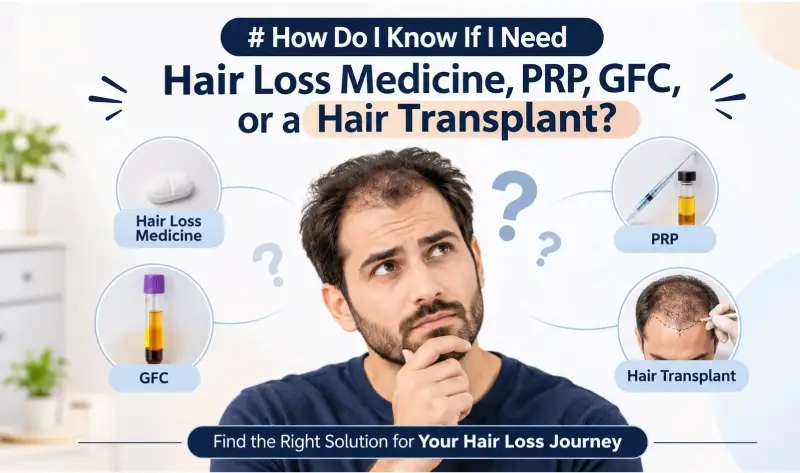
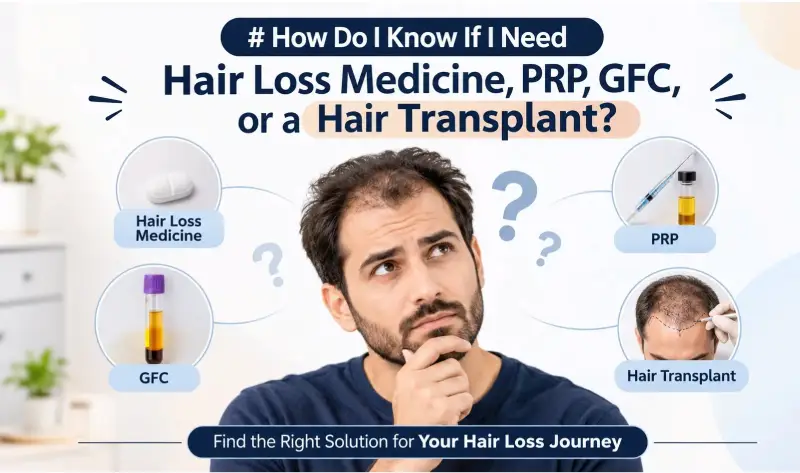
Hair loss often brings an inevitable question: Should I take medicine, try PRP or GFC, or do I actually need a hair transplant?
The answer is not determined by how much hair you see falling out.
Hair loss treatment depends on why you are losing hair, whether the follicles are still functioning, how advanced the loss is, and how much permanent coverage has already been lost. A dermatologist may recommend medication for one person, GFC or PRP for another, and a hair transplant for someone with a similar-looking problem but a different stage of hair loss.
At Chandra Hair Clinic in Delhi, Dr. Urvashi Chandra follows this treatment-first approach. According to the clinic, hair transplantation is suggested only when medicines and GFC are unlikely to sufficiently revive or recover the lost hair.
So, what does each option actually do?
Hair-loss medicines are generally considered when the follicles are still present and there is an opportunity to slow further loss, maintain existing hair or improve the thickness of miniaturised strands.
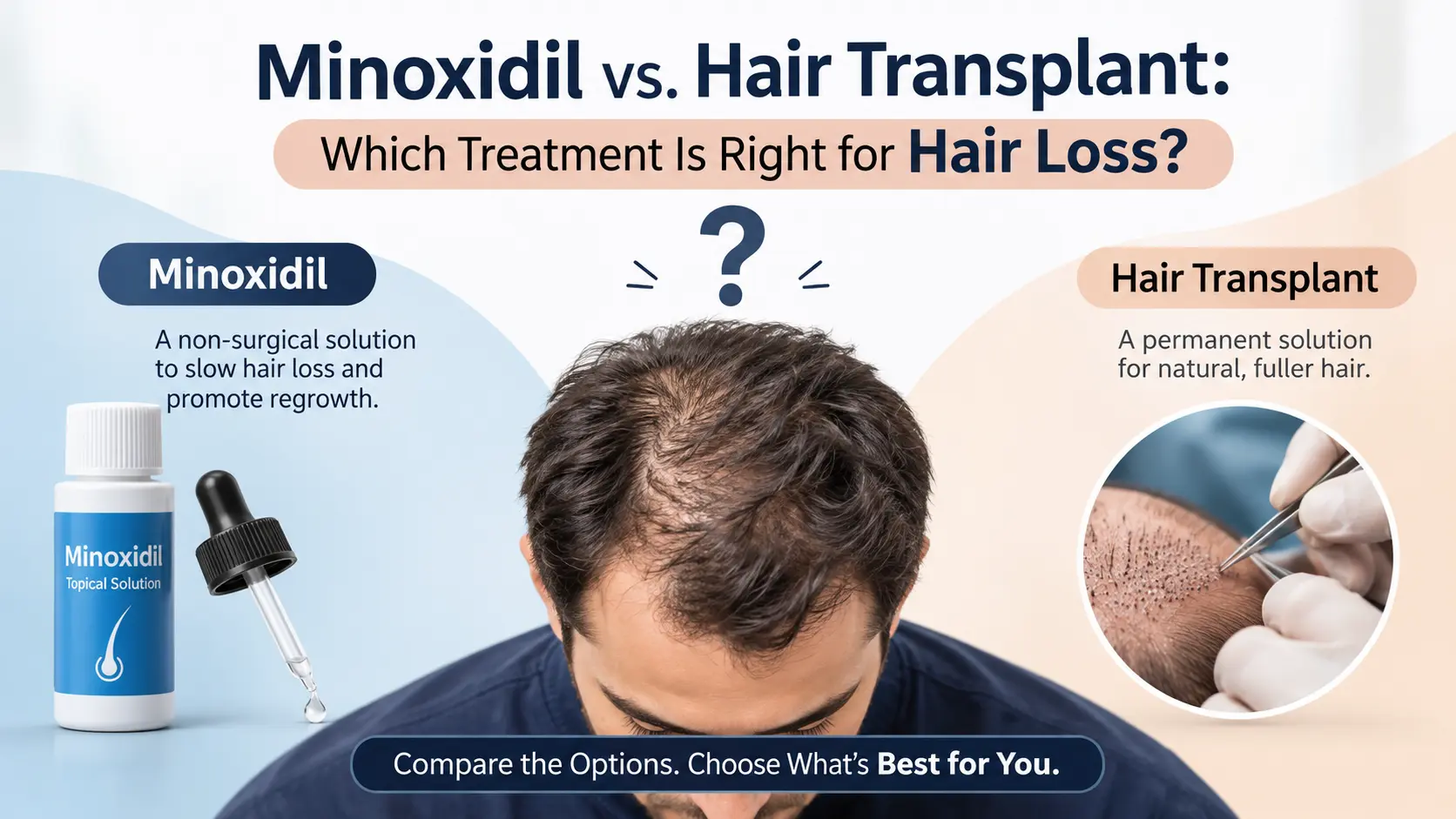
Minoxidil is one of the commonly used medical treatments for pattern hair loss. Depending on the diagnosis and patient, a dermatologist may also consider other prescription medicines. The exact medication should be based on the type of hair loss, age, sex, medical history and other individual factors.
However, medicines cannot be expected to recreate a large amount of hair in an area where follicles have already been permanently lost.
PRP, or Platelet-Rich Plasma, is a procedure that uses a patient's own blood. A small amount of blood is collected, processed to separate the platelet-rich component, and then injected into areas of hair thinning.
PRP is different from taking hair-loss medicine every day. It is a procedure-based treatment that may be used to support hair growth and reduce hair loss in selected patients.
GFC stands for Growth Factor Concentrate. Like PRP, it is a non-surgical treatment that uses components derived from the patient's own blood, but the preparation and concentration process are different.
The objective of GFC treatment is to deliver concentrated growth factors to the scalp in an effort to support the activity and health of hair follicles. At Chandra Hair Clinic, GFC is offered as one of the hair-growth treatments for patients with hair thinning and early hair loss.
GFC may be considered when:
A hair transplant addresses a fundamentally different problem.
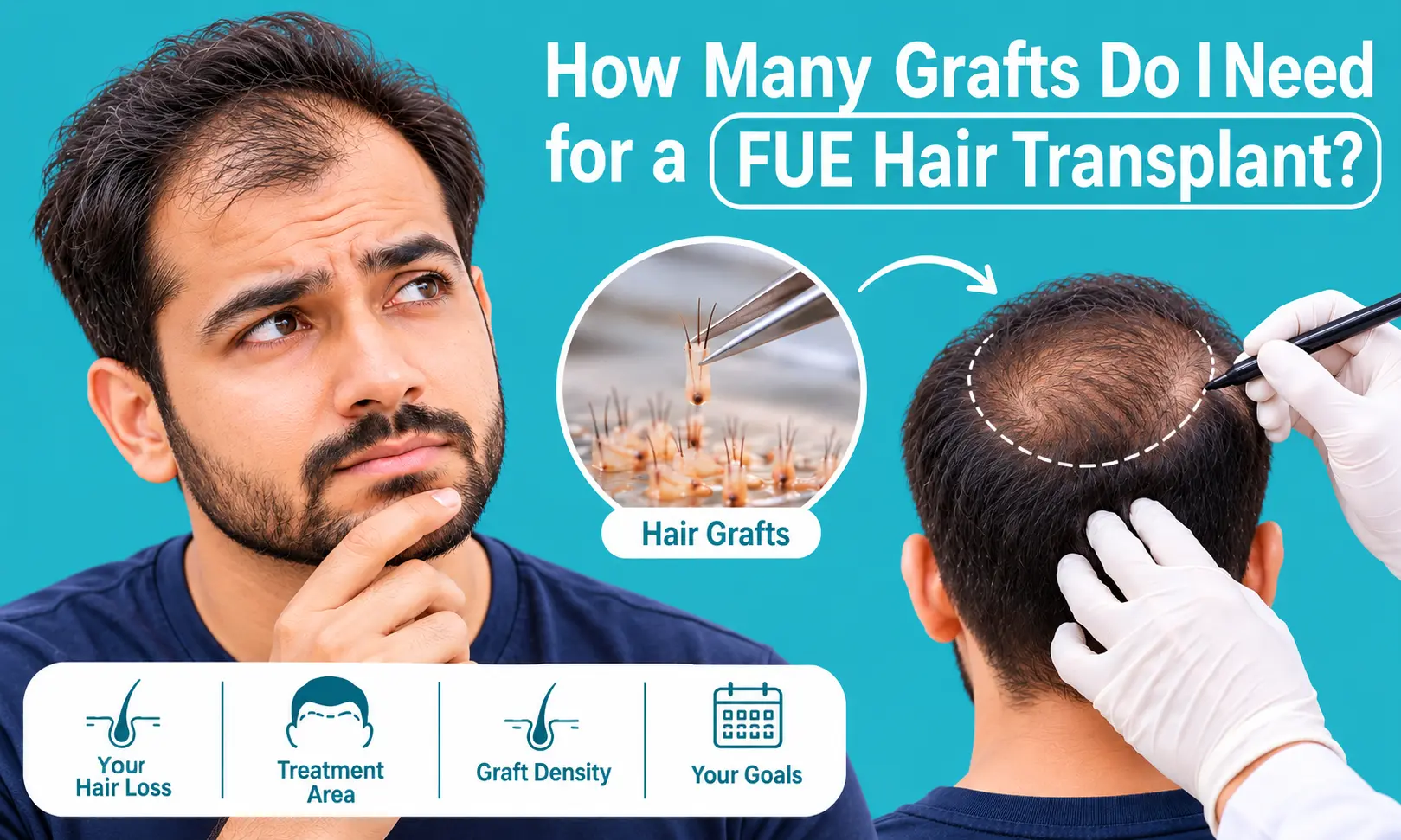
Instead of trying to stimulate weakened follicles, a transplant moves healthy follicular units from a suitable donor area to areas where hair has been lost.
In FUE, individual follicular units are extracted from the donor area and implanted into carefully planned recipient areas. Modern transplantation can produce natural-looking results because follicles are placed individually and the hairline, direction and density can be planned according to the patient's characteristics.
| Treatment | Main purpose | Usually considered when | Can it replace permanently lost follicles? |
| Hair-loss medicine | Slow loss and support existing hair | Early or ongoing thinning | No |
| PRP | Support existing follicles and improve hair parameters | Selected cases of thinning | No |
| GFC | Deliver concentrated growth factors to the scalp | Selected cases of thinning/early loss | No |
| Hair transplant | Restore hair coverage using donor follicles | Established loss with suitable donor hair | Yes, by relocating existing follicles |
The table gives a useful distinction, but real patients rarely fit into four perfectly separate boxes.
It is tempting to look at photographs online and decide, “My hair looks like this, so I need GFC,” or “My hairline has receded, so I need 2,000 grafts.”
But the visible appearance of hair loss does not tell the whole story.
A professional hair expert needs to assess:
Only after this assessment can the appropriate treatment be selected.
Dr. Urvashi Chandra is an MBBS and MD in Dermatology and a Diplomate of the American Board of Hair Restoration Surgeons. She has more than 16 years of experience in hair transplantation and advanced hair-loss treatments.
The clinic's approach is particularly relevant to this question because a hair transplant is not treated as the default answer to hair loss. Dr. Chandra recommends transplantation when simpler options such as medicines and GFC are unlikely to recover the lost hair sufficiently; when transplantation is appropriate, she explains the procedure and its expected outcome to the patient.
Chandra Hair Clinic also offers FUE, Bio-IPT and other hair-restoration options alongside non-surgical hair-loss treatments. This allows treatment planning to begin with the patient's hair-loss condition rather than with a particular procedure.
Think of the four options this way:
Medicine may be about protecting the hair you still have.
PRP or GFC may be considered when the follicles are still present and the objective is to support existing hair and improve density.
Hair transplant becomes relevant when there is significant permanent hair loss and healthy donor follicles can be used to restore coverage.
But these are general principles, not a self-diagnosis checklist.
The same amount of visible thinning can require completely different treatment in two people because the underlying cause, follicle health and donor supply may be different.
The biggest mistake people make with hair loss is trying to choose the procedure before understanding the problem.
Medicine, PRP, GFC and hair transplantation each have a place, but they work in different ways. If the follicles are still functioning, treatment may focus on preserving and strengthening them. If significant hair has already been lost, a transplant may be considered to restore coverage using healthy donor follicles.
And sometimes the answer is not one treatment at all.
The right decision comes after a proper examination of what caused your hair loss, how much hair remains, how much can realistically be recovered and what is likely to happen in the future. Ultimately, it is the dermatologist or hair-restoration surgeon who should determine whether you need medicine, PRP, GFC, a hair transplant, or a combination of treatments.
Both GFC and medicine work differently, so one cannot be considered universally better. The appropriate option depends on the cause and stage of hair loss and whether the follicles are still capable of producing hair.
These treatments are intended to support existing or weakened follicles and are generally not a way to recreate follicles that have been permanently lost.
You usually cannot determine this simply by looking at your scalp. A hair specialist can assess the pattern, follicle health, duration of hair loss and other factors to determine whether regrowth is realistic.
It may be recommended in some cases, particularly when active hair loss is continuing. However, whether medication is appropriate depends on the diagnosis and the individual patient's circumstances.
They may be used in selected patients as part of an overall hair-maintenance plan, but the decision should be made by the treating doctor based on the patient's native hair and ongoing hair loss.
A transplant may not be appropriate when there is insufficient donor hair, unstable or unexplained hair loss, certain active scalp conditions, or when the expected result is not realistically achievable. A proper examination is needed before making that decision.
Not necessarily. A transplant and medical or regenerative treatments solve different parts of the hair-loss problem, and some patients may use more than one approach as part of long-term hair management.