If you have started researching an FUE hair transplant, one of the first numbers you will probably come across is “How many grafts do I need?” You may see estimates of 1,500, 2,000, 3,000 or even 4,000+ grafts online. But there is no standard graft number that works for everyone.
The number of grafts required for an FUE hair transplant depends on where you have lost hair, how large the area is, your existing hair density, the characteristics of your hair and, importantly, how much healthy donor hair is available.
At Chandra Hair Clinic in Delhi, Dr. Urvashi Chandra approaches hair transplantation by assessing these factors rather than deciding the graft count from the Norwood stage alone. Her approach is to first determine whether a transplant is actually required and then plan the procedure around the patient's current and future hair restoration needs.
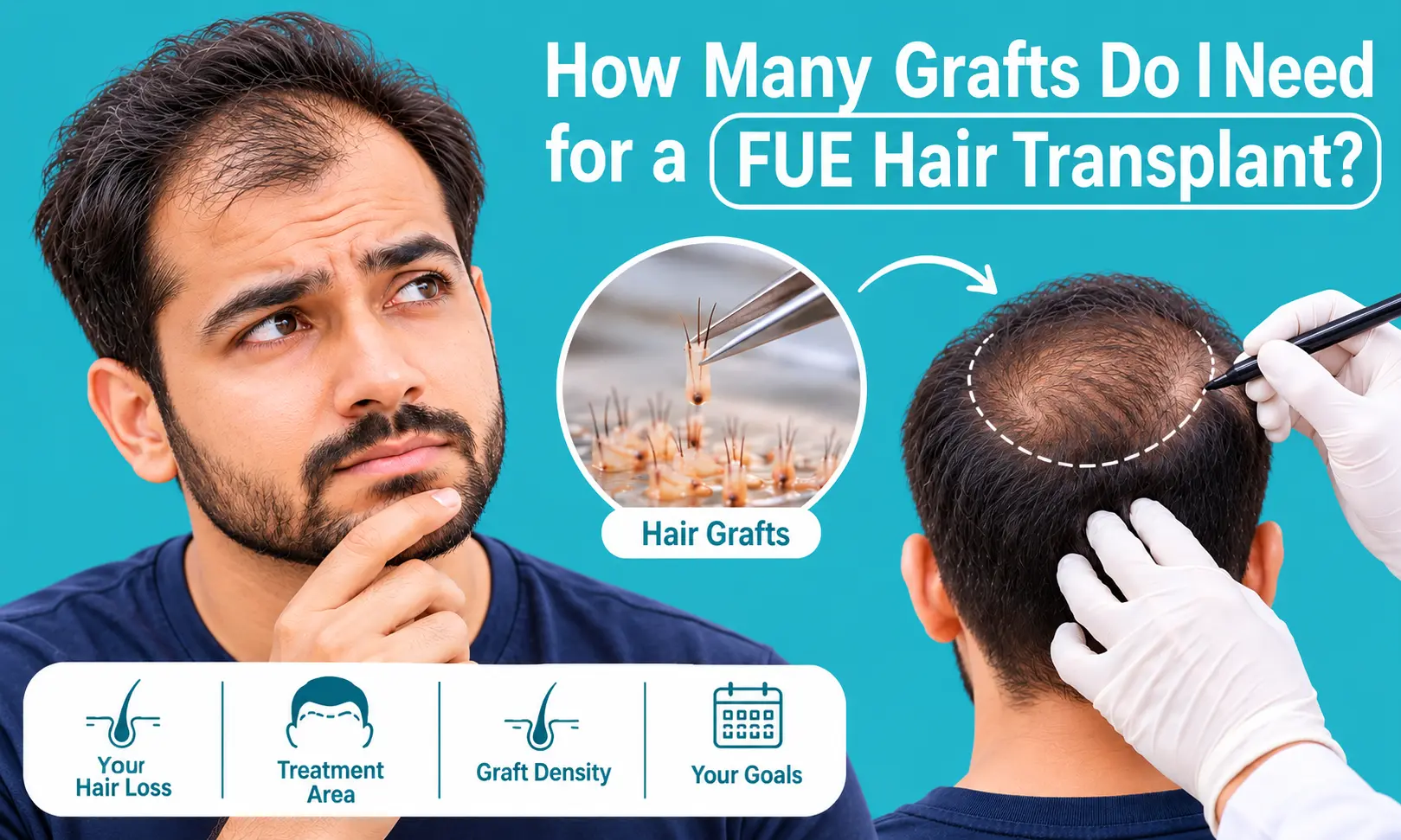
A graft is a small follicular unit containing one or more hair follicles. In FUE, these follicular units are individually extracted from the donor area, usually the back and sides of the scalp, and transplanted into areas affected by hair loss.
This is important because 1,000 grafts does not necessarily mean 1,000 hairs.
A graft may contain one, two, three or sometimes more hairs. Therefore, surgeons consider not only the number of grafts but also the number of hairs within those grafts when planning a transplant.
For example, two patients may both receive 2,000 grafts but achieve different levels of visual coverage depending on their average number of hairs per graft, hair thickness and existing hair density.
There is no fixed number, but a broad estimate can help you understand what different levels of restoration may involve.
| Hair loss area | Approximate graft range |
| Hairline/temples | 800–2,000+ grafts |
| Front and mid-scalp | 1,500–3,000 grafts |
| Crown/vertex | 1,000–2,500+ grafts |
| Front + mid-scalp + crown | 3,000–4,500+ grafts |
The hairline often requires fewer grafts than full-scalp restoration because the area being treated is relatively limited.
Depending on the extent of recession and the desired hairline design, it may require roughly 800 to 2,000 or more grafts.
The number is also influenced by how far the hairline has receded and whether the temples need reconstruction.
When hair loss extends behind the hairline into the frontal and mid-scalp region, more grafts are required.
A moderate restoration may fall around 1,500 to 3,000 grafts, although the exact requirement depends on the size of the thinning area and the amount of existing hair that can be preserved.
The crown can be particularly challenging because of its circular or whorl-like growth pattern.
A transplant may require approximately 1,000 to 2,500+ grafts, depending on the size of the thinning or bald area.
However, crown restoration has to be planned carefully. Trying to achieve very high density in a large crown area can consume a significant portion of the available donor supply.
If hair loss affects the hairline, frontal scalp, mid-scalp and crown, the requirement can reach 3,000–4,500 or more grafts.
In extensive baldness, however, simply increasing the graft number is not always the answer. The surgeon may need to prioritise certain areas or divide restoration into multiple sessions depending on donor capacity and the patient's goals.
The Norwood scale is useful for describing the pattern and progression of male pattern hair loss, but it cannot independently determine the number of grafts required.
As a broad guide:
| Hair loss pattern | Possible graft requirement |
| Early recession | 500–1,500+ |
| Moderate frontal/mid-scalp loss | 1,500–3,000 |
| Advanced loss | 3,000–5,000+ |
These ranges overlap because two people at the same Norwood stage can have very different scalp sizes, hair characteristics, donor density and expectations.
This is why a surgeon should not recommend a graft number simply by looking at your Norwood stage.
The larger the area requiring restoration, the more grafts are generally needed.
A person with recession limited to the temples will obviously require a different plan from someone with significant frontal and crown baldness.
If thinning hair is still present in an area, the goal may be to increase density rather than completely fill a bald surface.
This can reduce the number of grafts required while helping the transplanted hair blend with existing hair.
Coarser hair can provide more visual coverage than very fine hair.
This means two people with similarly sized bald areas may require different graft numbers to achieve a comparable cosmetic effect.
A graft can contain different numbers of hairs. Therefore, the surgeon considers the average follicular unit composition of your donor area rather than looking only at the total graft count.
The donor area places a natural limit on what can be transplanted.
FUE involves removing individual follicular units from the donor area, and overharvesting can lead to visible thinning of the donor region. ISHRS guidance recommends comparing the grafts required in the recipient area with the number that can be safely harvested from the donor area.
This is one reason why “Can I get 5,000 grafts?” is not a question that can be answered safely without examining the donor area.
A transplant has to be planned for the future, not just for today's baldness.
If native hair around the transplanted area continues to thin, an overly aggressive hairline or excessive use of donor grafts early on can create problems later. A responsible plan therefore considers the likely progression of hair loss and the donor supply that may be needed in the future.
It can be, but it depends entirely on what you are trying to restore.
For example, 2,000 grafts may be enough for a moderate hairline and temple restoration in one person. Another patient with extensive frontal and crown loss may require significantly more grafts.
The more useful question is not “Is 2,000 grafts enough?” but “What area can 2,000 grafts realistically restore in my case?”
Usually, 3,000 grafts would not be expected to recreate dense coverage across a completely bald, large scalp area.
However, it can provide meaningful restoration when the grafts are strategically distributed across the hairline, frontal region and other priority areas.
For advanced hair loss, the surgeon may recommend prioritising the frontal region because restoring the frame of the face can make a substantial visual difference without using the entire donor reserve at once.
At Chandra Hair Clinic in Delhi, FUE involves individually extracting follicular units from the donor area and implanting them into the areas affected by hair loss. The clinic states that FUE procedures are customised after assessing the patient's hair loss, donor area and desired restoration rather than following a one-size-fits-all graft count.
The clinic is led by Dr. Urvashi Chandra, who carries more than 16 years of experience in hair transplantation and hair-loss treatment and has been performing Bio-IPT at Chandra Hair Clinic since 2015.
Importantly, Dr. Chandra's approach is not to treat every patient with a transplant automatically. According to the clinic, she recommends transplantation when medicines and GFC therapy are unlikely to sufficiently restore the lost hair.
There is no magic number of grafts that every FUE patient needs. A hairline restoration may require hundreds or around 1,000–2,000+ grafts, moderate restoration may require around 1,500–3,000, while extensive hair loss can require 3,000–4,500+ grafts or staged procedures.
But these figures should be treated as starting points, not promises. Your ideal graft number depends on the size of the area being restored, existing hair, hair characteristics, donor density and your future hair-loss pattern.
A good FUE plan is therefore not about getting the maximum possible number of grafts. It is about using the available donor hair intelligently to create natural-looking coverage while preserving your options for the future.
A Norwood 3 patient may need roughly 1,000–2,500+ grafts, but the actual number depends on the degree of recession, hairline design, existing density and donor supply.
It can be enough for some patients, particularly when recession is limited, but the required number depends on the size of the temples and hairline and the density being targeted.
There is no fixed number because each graft can contain one or several hairs. The surgeon therefore considers both graft count and the average number of hairs per graft.
It may be possible when the area is limited and the donor supply is sufficient, but extensive hair loss may be better managed by prioritising areas or planning more than one session.
Not necessarily. Density also depends on graft distribution, the number of hairs within each graft, hair thickness and the amount of existing native hair.
You can discuss your desired level of coverage with your surgeon, but the medically appropriate graft number should be determined after assessing your recipient area and donor capacity.